

Common Mistakes in Indoor Air Quality Testing and How to Avoid Them
Indoor air quality (IAQ) has become a critical metric for building safety, tenant health, and regulatory compliance. According to the Environmental Protection Agency (EPA), people spend approximately 90 percent of their time indoors, where pollutant levels can be two to five times higher than outdoor levels. This statistic underscores the necessity of accurate IAQ assessments for commercial and residential properties alike. However, many property owners and facility managers make critical errors during the testing process, leading to false negatives, unnecessary remediation costs, or continued exposure to hazardous materials. Avoiding these pitfalls requires a strategic approach to sampling, equipment selection, and professional interpretation of data. (Contact us Dmvenvironmental)
1. Ignoring Pre-Testing Surveys and Site History
One of the most frequent errors in IAQ assessment is skipping the preliminary site survey. Many property owners assume that a standard air sample will reveal all issues. This is incorrect. Asbestos, lead, and mold require distinct sampling methodologies. For instance, the EPA mandates that any building undergoing renovation or demolition must undergo an asbestos survey, regardless of the building's age. Without a pre-testing survey, you may miss hidden hazards in insulation, flooring, or ceiling tiles.
DMV Environmental emphasizes the importance of a comprehensive initial assessment. Our team conducts detailed inspections to identify potential sources of contamination before deploying air monitoring equipment. This proactive approach ensures that the testing phase targets the correct contaminants, whether it is airborne asbestos fibers, lead dust, or volatile organic compounds (VOCs). Skipping this step often results in wasted resources and incomplete data.
2. Improper Sampling Location Selection
The placement of air quality monitors is critical for obtaining representative data. A common mistake is placing sensors in dead air zones, near ventilation intakes, or in areas with high foot traffic. These locations can skew results, providing false readings that do not reflect the general indoor environment.
For accurate Indoor Air Quality (IAQ) investigations, monitors should be placed in occupied zones where people spend the most time, such as conference rooms, open-plan offices, and residential living areas. Additionally, sampling should avoid direct drafts from HVAC vents, as this can artificially lower particulate counts. DMV Environmental’s certified inspectors use strategic placement protocols to ensure that every data point reflects the true air quality experienced by occupants.
3. Equipment Calibration and Maintenance Errors
Using uncalibrated or poorly maintained equipment is a fatal flaw in any IAQ study. Sensors drift over time, and filters can become clogged, leading to inaccurate readings. For example, a mold sampler that is not calibrated correctly might underreport spore counts, giving a false sense of security to building owners.
Professional firms like DMV Environmental utilize industry-standard, calibrated equipment for all mold investigations and remediation design phases. Regular maintenance and calibration checks are part of our operational protocol. This ensures that the data collected during mold and moisture control programs is legally defensible and scientifically accurate. DIY kits often lack this level of precision, making them unsuitable for commercial compliance or litigation support.
4. Ignoring HVAC System Influences
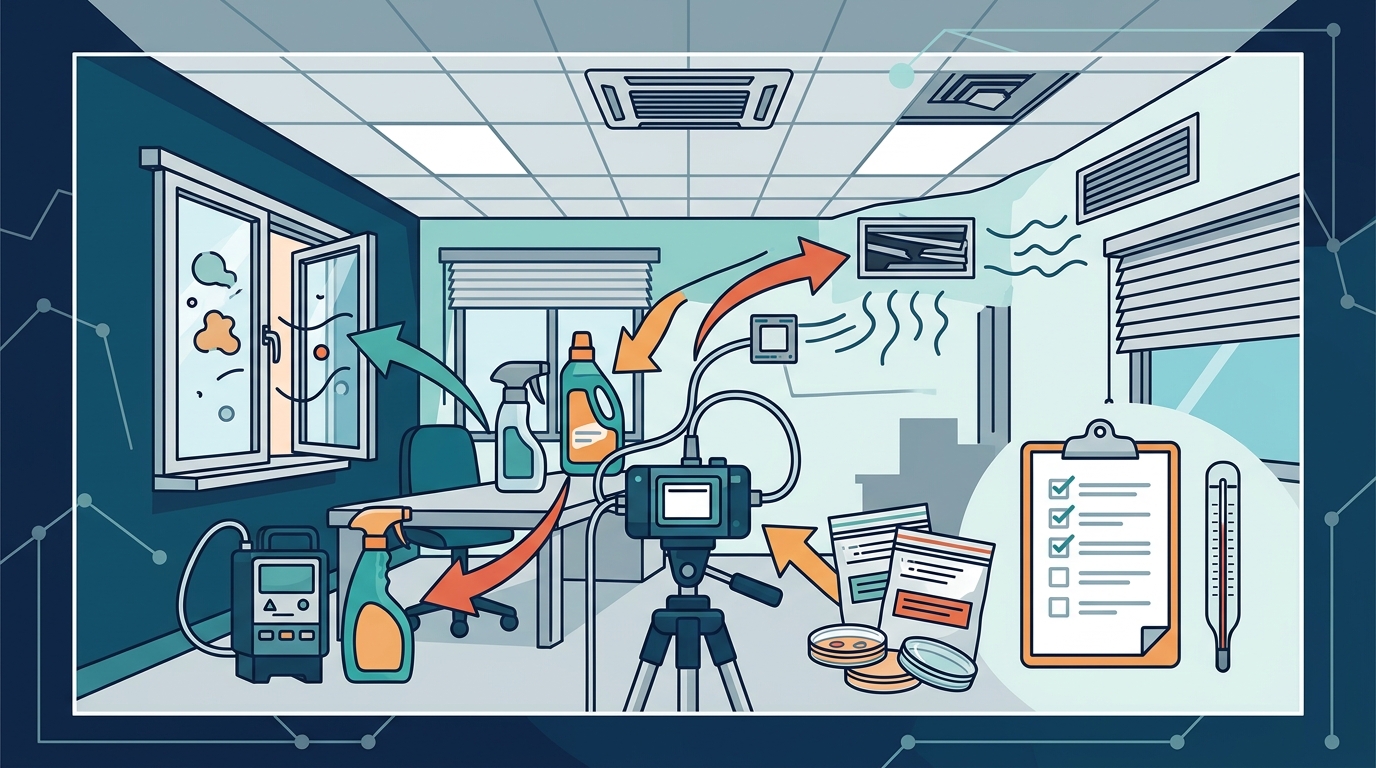
The Heating, Ventilation, and Air Conditioning (HVAC) system is the lungs of any building. Ignoring its condition during IAQ testing is a major oversight. Dirty filters, mold growth in ductwork, or improper ventilation rates can severely degrade indoor air quality. Many property owners test the air but fail to inspect the source of the problem.
Comprehensive IAQ assessments must include an evaluation of the HVAC system. This includes checking for proper filtration efficiency, duct integrity, and outdoor air intake rates. DMV Environmental’s Indoor Air Quality (IAQ) services include Sick Building Response Surveys that specifically target these mechanical failures. By addressing the root cause within the HVAC system, we help building owners reduce liability and optimize building operations.
5. Misinterpreting Radon and Mold Data
Radon is the leading cause of lung cancer in non-smokers. However, many property owners misunderstand the testing process. Radon levels fluctuate based on weather, season, and building pressure. A single short-term test may not provide an accurate long-term average. Furthermore, radon testing should be conducted in residential rental properties, and is strongly encouraged for all properties.
Similarly, mold data is often misinterpreted. Finding mold spores does not automatically mean there is a health hazard. The type of mold, the concentration, and the presence of moisture are all critical factors. DMV Environmental provides comprehensive services to prevent mold issues, investigate moisture intrusion, and recommend prudent remediation measures. We understand how mold affects occupant health, insurance practices, and potential litigation, ensuring that our clients receive actionable insights rather than just raw data.
6. Choosing Between Professional and DIY Testing
While DIY testing kits are available, they often lack the sensitivity and specificity required for commercial properties or complex residential cases. Professional testing provides a holistic view, including industrial hygiene assessments and hazardous material surveys. DMV Environmental is staffed with professional inspectors who are appropriately certified and licensed to perform asbestos services in Maryland, DC, and Virginia.
For businesses, the cost of a professional assessment is negligible compared to the cost of remediation or legal liability from undetected hazards. Our team specializes in doing work in hotels, high-rise office buildings, and private schools, ensuring that every project meets the highest standards of safety and compliance.
Comparison of Testing Approaches
| Feature | DIY Testing Kits | Professional IAQ Assessment |
|---|---|---|
| Accuracy | Low to Moderate | High (Calibrated Equipment) |
| Scope | Limited to one contaminant | Comprehensive (Asbestos, Lead, Mold, IAQ) |
| Interpretation | Self-reported, often unclear | Expert analysis and remediation planning |
| Compliance | Not legally defensible | Meets EPA and OSHA standards |
| Cost | Low upfront | Investment in long-term safety |
Key Takeaways
- Pre-Testing Surveys are Mandatory: Always conduct a site survey to identify potential hazards before sampling.
- Strategic Sensor Placement: Place monitors in occupied zones, away from HVAC drafts and dead air spots.
- Calibration is Critical: Use professionally calibrated equipment to ensure data integrity and legal defensibility.
- HVAC Integration: Evaluate the HVAC system as part of the IAQ assessment to address root causes of pollution.
- Radon Awareness: Test for radon in all residential and rental properties, as it is a leading cause of lung cancer in non-smokers.
- Professional Expertise: Hire certified inspectors for asbestos, lead, and mold services to ensure compliance with EPA regulations.
- Comprehensive Reporting: Choose providers who offer remediation design and scope of work plans, not just testing.
Frequently Asked Questions
What is Indoor Air Quality (IAQ)?
Indoor Air Quality (IAQ) refers to the air quality within and around buildings and structures, especially as it relates to the health and comfort of building occupants.
Why is pre-testing survey important for asbestos?
A pre-testing survey is important for asbestos because the EPA requires that any building undergoing renovation or demolition undergo an asbestos survey regardless of age to ensure safe handling and abatement.
How does DMV Environmental handle mold investigations?
DMV Environmental provides comprehensive services to prevent mold issues, investigate moisture intrusion, and recommend prudent remediation measures, including clearance inspections.
What is the EPA recommendation for radon levels?
The EPA recommends testing for radon in both air and water, and taking action if levels are above 4 pCi/L in air or 4,000 pCi/L in water.
Can DIY testing kits replace professional IAQ assessments?
No, DIY testing kits often lack the sensitivity and specificity required for commercial properties or complex residential cases, and they do not provide legally defensible data.
What services does DMV Environmental offer for industrial hygiene?
DMV Environmental offers programs and services designed to promote workplace health and safety, including anticipating, recognizing, evaluating, and controlling workplace conditions and hidden hazards.
How often should IAQ testing be conducted?
IAQ testing should be conducted regularly, especially after renovations, water damage, or if occupants report health issues, to maintain a healthy indoor environment.
Secure Your Property’s Safety Today
Don’t let common mistakes compromise the health of your tenants or the value of your property. DMV Environmental provides a multitude of services including asbestos, lead, mold inspections/investigations, and indoor air quality (IAQ) assessments. Our professional staff and certified inspectors have the industry knowledge and experience to complete your project with accuracy and excellence. Contact us today to schedule your assessment and ensure your building meets the highest safety standards.