
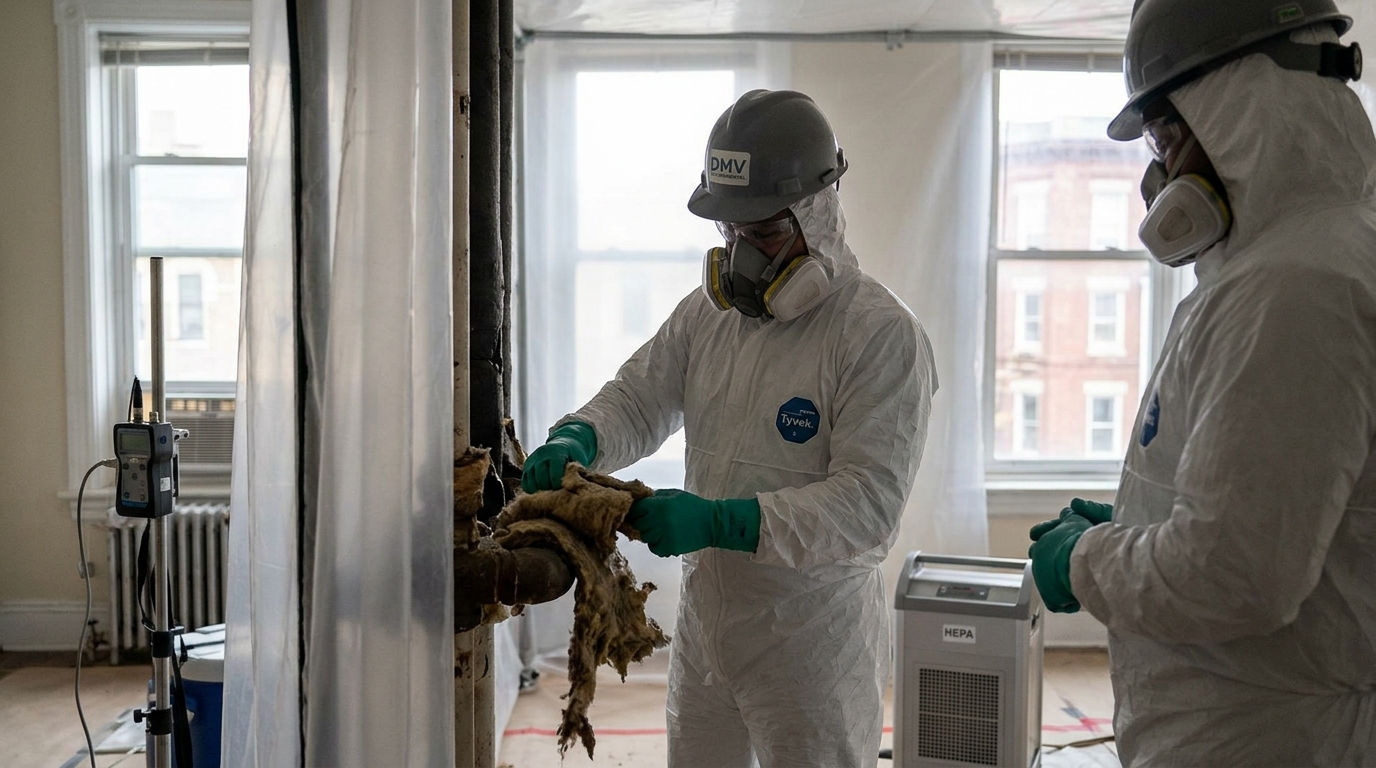
Asbestos removal companies in Washington DC must hold a specific abatement permit issued by the Department of Energy and Environment (DOEE) and employ certified professionals trained under the EPA Model Accreditation Plan. These requirements ensure that contractors protect the health of building occupants and workers while managing hazardous materials safely. DMV Environmental operates as a Certified Business Enterprise in Washington DC, providing compliant inspection and abatement services across the tri-state area.
Regulatory Framework and DOEE Oversight
The District of Columbia has a dedicated regulatory body for managing asbestos hazards. The DOEE Asbestos Abatement Program is responsible for issuing permits to licensed contractors and monitoring their work. This program ensures that asbestos removal contractors protect their own health and safety, as well as the health of building occupants and the general public. According to the DOEE, the program inspects and monitors asbestos abatement projects and reviews final reports. This oversight is critical because asbestos is a known carcinogen, and improper handling can lead to severe health consequences.
Permitting and Compliance
Before any abatement work begins, a contractor must obtain a permit from DOEE. The permit process involves submitting detailed plans that outline the scope of work, containment methods, and decontamination procedures. Compliance is not optional; failure to follow these regulations can result in significant fines and legal liability. DMV Environmental helps clients navigate these complex regulations with precision, ensuring that every project meets local legal standards.
Professional Certification Requirements
While the company holds the permit, the individuals performing the work must be certified. To become a properly trained and accredited asbestos professional, you must seek training from a provider that offers courses approved by the EPA or a state to conduct asbestos training pursuant to the Asbestos Model Accreditation Plan. This plan sets the minimum training requirements for asbestos professionals. Certification ensures that workers understand the specific risks associated with different types of asbestos-containing materials.
Training Components
Hands-on training is a core component of certification. It includes the use of respirators, removal and repair of simulated asbestos materials, and the installation and removal of glove bags. Workers must also learn how to construct containments and perform decontamination procedures. The initial course typically requires a final exam score of 70% or higher to issue a certification license card. DMV Environmental staff are certified and licensed to perform these services, ensuring that your project is handled by qualified experts.
Scope of Work and Project Management
A qualified asbestos removal company does more than just remove materials. They assess the building's foundation, identify entry points for hazardous materials, and design a system tailored to the structure. This includes managing the project timeline and coordinating with other trades during renovations. Professional oversight ensures that the abatement process operates efficiently and that air quality remains safe. For example, in a high-rise office building, the contractor must coordinate with HVAC systems to prevent the spread of fibers to other floors. according to Asbestos Certification L
Monitoring and Clearance
After abatement is complete, air monitoring is required to verify that fiber levels are below the action threshold. This step is crucial for ensuring that the space is safe for re-occupancy. DMV Environmental provides written scope of work and ongoing monitoring, giving property owners the confidence that the job is done right. The clearance inspection is the final step in the regulatory process, confirming that all asbestos-containing materials have been properly removed or encapsulated.
Service Areas and Specializations
Asbestos regulations can vary slightly between jurisdictions, but the core requirements in DC, Maryland, and Virginia are similar. DMV Environmental is staffed with professional inspectors who are appropriately certified and licensed to perform asbestos services in all three states. This multi-state capability is essential for property owners with assets across the DMV region. The company specializes in high-end hotels, high-rise office buildings, and residences, where the complexity of abatement is often higher.
Local Expertise
Understanding local building codes and historical construction practices is vital. Many buildings in the DC area were constructed during the peak usage era of asbestos-containing materials. Local expertise allows contractors to anticipate potential hazards and plan accordingly. DMV Environmental's team has extensive experience in the Mid-Atlantic market, providing a local and compliant option for property owners.
Key Takeaways
- Asbestos removal companies in DC must hold a permit from the DOEE Asbestos Abatement Program.
- Individual workers must be certified under the EPA Model Accreditation Plan.
- Training includes hands-on components such as respirator use and containment construction.
- Post-abatement air monitoring is required to verify safety before re-occupancy.
- DMV Environmental is a Certified Business Enterprise in Washington DC, serving the tri-state area.
- Compliance with local regulations is essential to avoid legal liability and ensure occupant safety.
Frequently Asked Questions
Who issues asbestos abatement permits in Washington DC?
The Department of Energy and Environment (DOEE) issues asbestos abatement permits to licensed contractors in the District of Columbia.
What is the EPA Model Accreditation Plan?
The EPA Model Accreditation Plan is a set of minimum training requirements for asbestos professionals, ensuring that workers are properly trained to handle hazardous materials.
Do asbestos removal companies need to be licensed in Maryland and Virginia?
Yes, contractors must hold specific certifications and licenses in Maryland and Virginia to perform asbestos abatement work legally in those states.
What happens after asbestos abatement is complete?
After abatement, air monitoring is conducted to verify that fiber levels are below the action threshold, and a clearance inspection is performed to confirm the space is safe.
Can I perform asbestos removal myself in DC?
No, asbestos removal in DC must be performed by licensed and certified professionals. DIY removal is illegal and poses significant health risks.
How does DMV Environmental ensure compliance?
DMV Environmental ensures compliance by employing certified inspectors, obtaining necessary permits, and providing ongoing monitoring and clearance inspections.
Conclusion
Understanding the licensing and certification requirements for asbestos removal in Washington DC is essential for property owners. By working with a compliant and certified provider, you can ensure that your project meets all regulatory standards and protects the health of your occupants. DMV Environmental is committed to providing safe and effective asbestos services in the DMV region. To plan your project, today.