
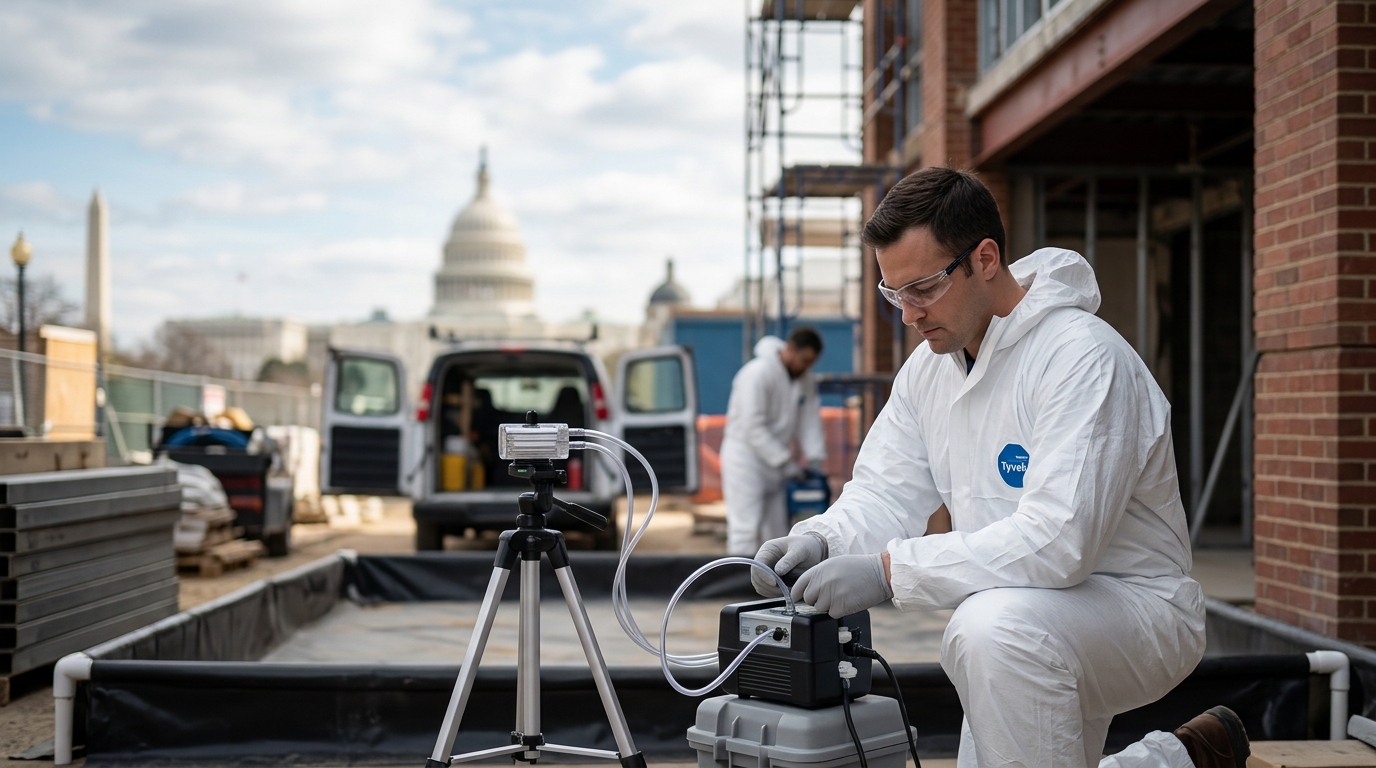
DMV Environmental provides certified asbestos air monitoring services in Washington DC, Maryland, and Virginia. This guide explains how air monitoring works, why it is legally required, and how to select a qualified provider. It covers the regulatory landscape, the difference between bulk and air sampling, and the specific steps for pre- and post-abatement clearance testing.
DC Environmental Companies
Washington DC has a dense population of environmental firms, but not all hold the specific certifications required for asbestos work. The District of Columbia Department of Health (DoH) regulates asbestos abatement and inspection activities strictly. A company must be certified by the state or local authority to perform these tasks legally. DMV Environmental is a Certified Business Enterprise in Washington DC, operating from 1629 K Street Northwest. Our team is licensed to perform asbestos services in Maryland, DC, and Virginia, ensuring compliance across the entire DMV region.
Regulatory Compliance in the District
Compliance in DC is not optional. The EPA requires that any building undergoing renovation or demolition undergo an asbestos survey regardless of age. This mandate applies to commercial properties, multi-family dwellings, and single-family homes. DMV Environmental’s inspectors are appropriately certified and licensed to navigate these regulations. We provide written scopes of work and ongoing monitoring to ensure that projects meet all federal and local standards. according to The reproducibility of
Why Local Expertise Matters
Local knowledge is critical for navigating the specific bureaucratic and physical challenges of DC properties. Many buildings in the District are historic, containing materials that are not found in newer construction. DMV Environmental specializes in high-end hotels, high-rise office buildings, and residences. Our experience in these specific sectors allows us to anticipate potential hazards and design efficient inspection protocols.
Asbestos Survey Services
An asbestos survey is a systematic investigation to identify and characterize asbestos-containing materials (ACMs) in a building. This process involves visual inspections and bulk sampling. Bulk sampling is the collection of material from a building for laboratory analysis to determine if it contains asbestos. The results of a survey dictate the management plan for the property.
Types of Surveys
Surveys generally fall into two categories: preliminary and comprehensive. A preliminary survey identifies obvious ACMs and areas of concern. A comprehensive survey involves destructive sampling to find hidden materials behind walls or under flooring. DMV Environmental performs both types, tailoring the scope to the project’s needs. For renovation or demolition, a comprehensive survey is typically required by the EPA.
The Role of Hazardous Materials Surveys
Asbestos is often found alongside other hazardous materials. DMV Environmental offers hazardous materials surveys that include water and soil sampling. This holistic approach ensures that all environmental risks are identified before work begins. By integrating asbestos surveys with broader hazard assessments, we provide a complete picture of the building’s environmental health. according to Asbestos Toxicity Who
Asbestos Air Monitoring
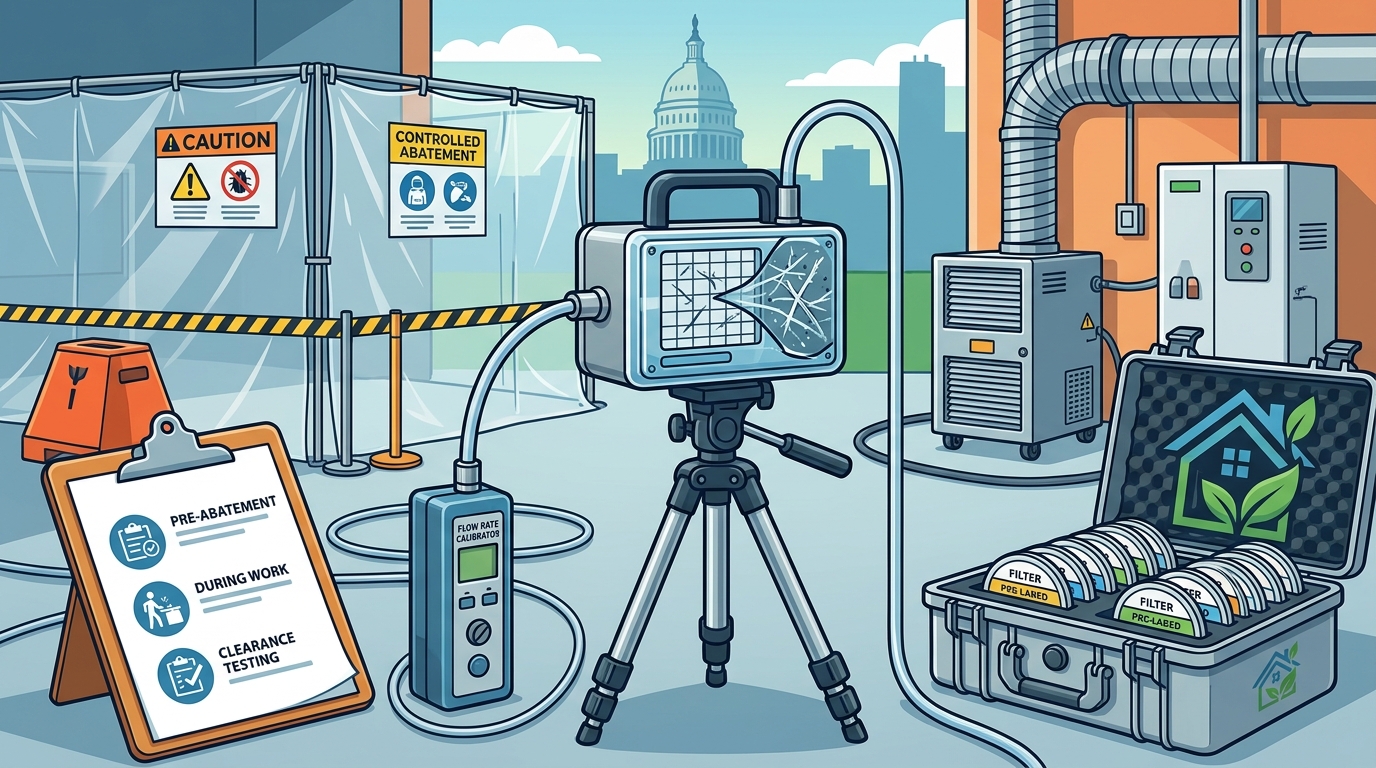
Asbestos air monitoring is the process of measuring airborne asbestos fiber concentrations to ensure worker and public safety. This service is critical during abatement and clearance testing. Air monitoring is distinct from bulk sampling because it measures the actual exposure risk in the breathing zone. The EPA and OSHA have established strict limits for airborne asbestos fibers.
Pre-Abatement Baseline Sampling
Post-Abatement Clearance Testing
Clearance testing is the final step in an asbestos abatement project. It verifies that the area has been cleaned and that fiber levels are below the clearance standard. In DC, the clearance standard is typically 0.01 fibers per cubic centimeter (f/cc) when using Phase Contrast Microscopy (PCM) or 0.005 f/cc when using Transmission Electron Microscopy (TEM). DMV Environmental provides independent clearance inspections to ensure that the abatement was successful and the space is safe for re-occupancy.
Monitoring During Abatement
Continuous monitoring is often required during active abatement to ensure that containment is effective. This involves placing air samplers in the work area and the adjacent occupied areas. If fiber levels rise above the action level, work must stop until the issue is resolved. Our team provides on-site monitoring to manage these risks in real-time.
DC Service Providers
Selecting the right service provider is crucial for the success of your asbestos project. In Washington DC, providers vary in their scope, certification, and experience. DMV Environmental offers a full suite of services, from initial surveys to final clearance. We also provide indoor air quality (IAQ) assessments and mold investigations, making us a one-stop resource for environmental health. according to Asbestos Toxicity What
Comparison of Service Capabilities
| Service Type | Description | DMV Environmental Offering |
|---|---|---|
| Asbestos Survey | Visual and bulk sampling to identify ACMs | Comprehensive and preliminary surveys |
| Air Monitoring | Measurement of airborne fiber levels | Baseline, during-abatement, and clearance testing |
| Lead Inspection | Identification of lead-based paint hazards | Inspections, risk assessments, and exposure monitoring |
| Mold Investigation | Assessment of mold and moisture issues | Investigations, remediation design, and clearance |
| IAQ Assessment | Evaluation of indoor air quality | WELL IAQ investigations and sick building surveys |
Emergency and Disaster Response
Environmental issues do not always follow a planned schedule. DMV Environmental has a dedicated team for emergency response services. This team handles water, fire, and hazardous material investigations. We provide moisture mapping, remediation protocols, and clearance inspections to help clients recover quickly from catastrophic events. Our ability to mobilize rapidly is a key advantage for property managers and building owners in the DC area.
Industrial Hygiene and Workplace Safety
DMV Environmental is committed to anticipating, recognizing, evaluating, and controlling workplace hazards. Our industrial hygiene programs are designed to promote workplace health and safety. By integrating asbestos and lead services with broader industrial hygiene consulting, we help businesses maintain compliant and healthy work environments.
Key Takeaways
- DMV Environmental is a Certified Business Enterprise in Washington DC, licensed for asbestos services in MD, DC, and VA.
- The EPA requires asbestos surveys for any building undergoing renovation or demolition, regardless of age.
- Asbestos air monitoring is distinct from bulk sampling and is critical for measuring actual exposure risk.
- Baseline air sampling must be conducted before abatement to establish background fiber levels.
- Clearance testing verifies that post-abatement fiber levels are below the regulatory standard of 0.01 f/cc (PCM).
- DMV Environmental provides comprehensive services including surveys, air monitoring, lead inspections, and mold remediation.
- Local expertise in DC’s historic and high-rise buildings is essential for effective environmental management.
- Emergency response teams are available for immediate action following fires, floods, or other disasters.
Frequently Asked Questions
Who is responsible for asbestos air monitoring in DC?
Asbestos air monitoring must be performed by a certified inspector or industrial hygienist. In Washington DC, the provider must be licensed by the local authority. DMV Environmental’s team is certified and licensed to perform these services in the DMV region.
What is the difference between bulk sampling and air monitoring?
Bulk sampling involves collecting a physical piece of material to test for asbestos content. Air monitoring measures the concentration of asbestos fibers in the air. Bulk sampling identifies the material, while air monitoring measures the exposure risk.
Is air monitoring required for all asbestos abatement projects?
Yes, air monitoring is generally required for all asbestos abatement projects. It includes baseline sampling before work begins and clearance testing after work is complete. This ensures that the abatement was effective and the area is safe.
How long does an asbestos survey take?
The duration of an asbestos survey depends on the size and complexity of the building. A small residential survey may take a few hours, while a large commercial building may take several days. DMV Environmental provides detailed timelines during the initial consultation.
Can DMV Environmental handle lead and mold issues as well?
Yes, DMV Environmental specializes in lead paint abatement, asbestos abatement, and mold remediation. We provide inspections, risk assessments, and remediation oversight for all three hazards.
What is the clearance standard for asbestos in DC?
The clearance standard for asbestos in DC is typically 0.01 fibers per cubic centimeter (f/cc) when using Phase Contrast Microscopy (PCM). Some projects may require the stricter 0.005 f/cc standard using Transmission Electron Microscopy (TEM).
Do you provide emergency services?
Yes, DMV Environmental has a dedicated disaster/emergency response team. We provide investigation, sampling, and consulting services for fires, floods, and other catastrophic events to help clients resume normal operations quickly.
Conclusion
Choosing the right partner for asbestos air monitoring in Washington DC is a critical decision for property owners and managers. DMV Environmental offers certified, comprehensive services that cover the full lifecycle of environmental management. From initial surveys to final clearance, our team ensures compliance and safety. To plan your visit or discuss your project, today.